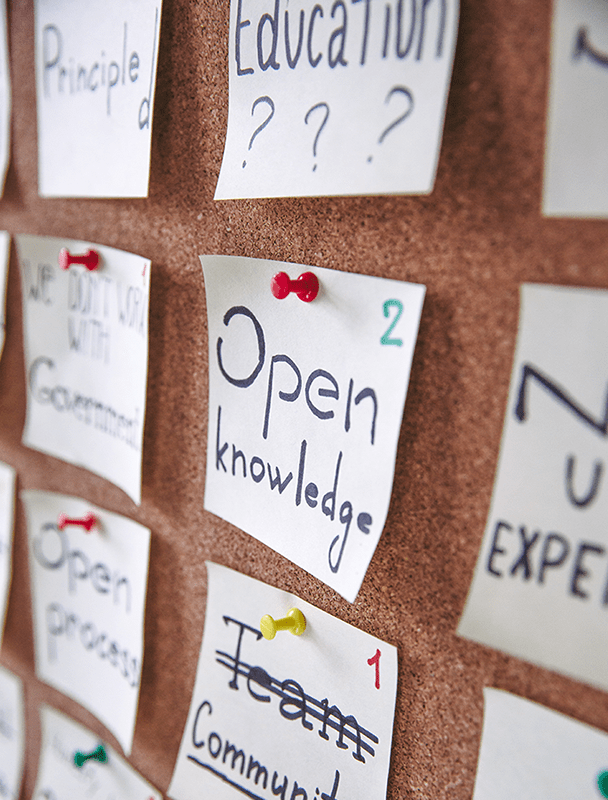
Since the creation of Visium360, we have developed a visual methodology allowing, with the client and in meetings, to define the detailed functional specifications of his needs.
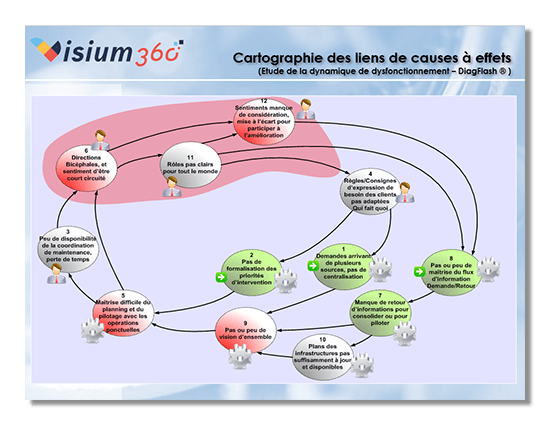
We thus intervene in the analysis of construction project, analysis of various dysfunctions, or change of an information system.
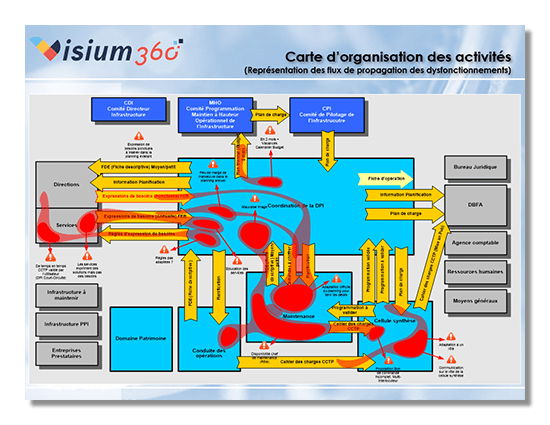
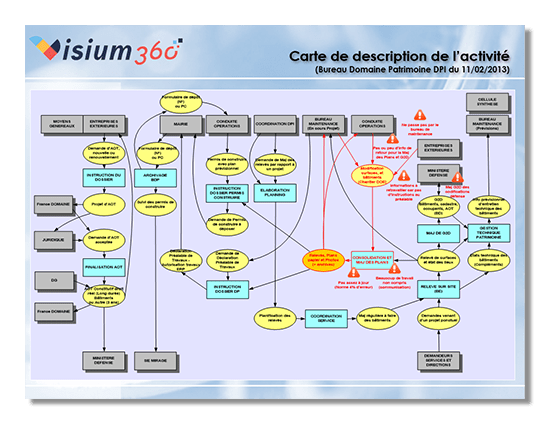
We have developed a certain number of mappings to be constructed, in each of the analysis contexts, in order to quickly lead to the solutions adopted.
This methodology is an integral part of our process digitalization platform, Coach360.
Advice and methodologies
Construction of an information system
Digitize the activity process.
Define the major information flows.
Build information structures.
Define all the management rules.
Define the functionalities to be implemented.
Build interfaces and forms.
Frame strategic indicators.
Â
System dysfunction analysis
Identify activities performance.
Describe the organization and the flow of exchanges.
Identify difficult areas.
Understand human needs.
Analyze System / Human interactions.
Find the levers for improvement.
Elaboration of changes to a system
Identify system malfunctions.
Evaluate possible change scenarios.
Build process changes taking into account existing activity.
Â
The visual methodology
The entire method is based on a succession of visual representations to be built with the client. Each analysis results in a functional map corresponding to a specific area of study. Thanks to this approach, the method makes it possible to cover all the notions or optimizations, of a technical or organizational system, in a completely visual way.
Collective construction
Playful and Educational Approach
Universal Language
Dynamics of Change
Human Dynamics
Encourage Orientations
Construction Collective
Le mÃĐtier de VISIUM360 est dâaider les entreprises à amÃĐliorer toujours plus la vision stratÃĐgique et opÃĐrationnelle quâelles ont de leurs activitÃĐs.
Le visuel permet toutes sortes de rÃĐflexions collectives, mettant en ÃĐvidence les difficultÃĐs relationnelles quâil faut identifier pour obtenir une visibilitÃĐ globale.
Toutes les constructions sont donc collectives afin dâobtenir une vision proche de la rÃĐalitÃĐ opÃĐrationnelle, à partir de diffÃĐrents angles de vue.
Approche ludique et pÃĐdagogique
La mÃĐthode sâorganise autour de lâÃĐlaboration de cartes, afin dâÊtre le plus proche possible dâune vision pragmatique et facile dâaccÃĻs. Chaque acteur va pouvoir participer à une sorte de jeu de construction, dont rÃĐsultera une meilleure comprÃĐhension des dysfonctionnements à ÃĐliminer, et permettra une communication plus large des objectifs à atteindre.
Universal language
Image is an universal language, which allows, without words, to explain or understand concepts and logics that can be complex.
The image helps to break down language barriers, and thus mixes actors who do not have the same level of knowledge or do not use the same type of vocabulary to express themselves.
Dynamique de changement
Lâaccompagnement aux changements est une dynamique indispensable dans la rÃĐussite de la mise en place dâune nouvelle organisation. Cela passe par un certain nombre dâÃĐlÃĐments que met en avant la mÃĐthode VISIUM360 ; principalement, la fÃĐdÃĐration collective dâun projet facile à prÃĐsenter progressivement, ainsi que la participation active des acteurs concernÃĐs par les changements.
L'approche humaine
On ne peut plus construire un systÃĻme technique en faisant abstraction du systÃĻme humain. Un systÃĻme dâinformation est une subtile fusion fragile entre la technologie et son utilisateur, relevant dâune ââthÃĐrapie de systÃĻmeââ.
Tenir compte de cette cohabitation, câest garantir un fonctionnement adaptÃĐ aux besoins des acteurs de lâentreprise, et les outils visuels permettent une approche plus humaine.
Encourage the right orientations
The solutions to well-functioning systems are found almost exclusively in the minds of corporate actors, in a fragmented way that does not take into account the whole. The cartographies will make it possible to bring the pieces together, to structure them and finally to place them in the collective context of the company.